How to Choose the Right Laser Module for Raman Spectroscopy
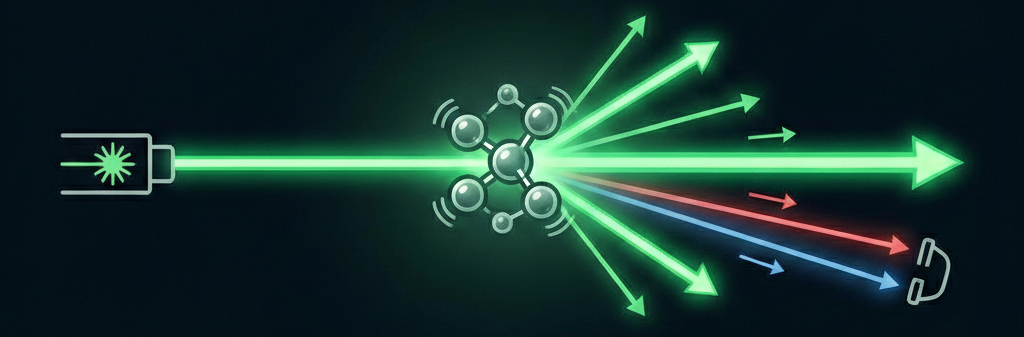
How to Choose the Right Laser Module for Raman Spectroscopy
A practical way to pick wavelength, power, and module style—so you spend less time fighting fluorescence and drift and more time collecting usable spectra.
Start with the sample
Raman spectra are built from a weak signal. Most projects run into one of these issues early:
- Fluorescence masking the Raman peaks (common with dyes, many organics, biological materials, and some packaging).
- Baseline and stray light near the laser line (filter limits, reflections, or laser spectral background).
- Drift that changes peak position or intensity over time (warm-up effects, temperature variation, or coupling changes).
Those three problems determine wavelength choice, power at the sample, and how stable/clean the laser module needs to be.
Wavelength selection: the decision that drives everything downstream
Shorter wavelengths tend to produce stronger Raman scattering, while longer wavelengths often reduce fluorescence. Here’s a quick way to think about the most common options you’ll see in real instruments.
532 nm (Green)
High signal Micro-Raman mapping
Good fit: many minerals, semiconductors, and materials mapping where spatial resolution and acquisition speed matter.
Watch for: fluorescence with many organics/dyes and higher risk of heating/photochemistry for absorbing samples.
633 / 638 nm (Red)
Middle ground Microscopy-friendly
Good fit: when you want stronger Raman than near-IR while reducing fluorescence compared to green (sample-dependent).
Watch for: some samples still fluoresce heavily; performance depends on chemistry and pigments.
785 nm (Near-IR)
Common default OEM + probes
Good fit: broad general-purpose Raman, especially for organics where fluorescence is a concern but not extreme.
Watch for: very fluorescent samples can still overwhelm; high-wavenumber bands push toward the edge of typical Si detector performance.
830 nm (Near-IR)
Fluorescence reduction Probe-friendly
Good fit: when 785 nm still struggles with fluorescence and your optics/detector support the band.
Watch for: not a universal fix; you may still need 1064 for difficult samples.
1064 nm (Near-IR)
Fluorescence suppression Architecture change
Good fit: highly fluorescent samples where 532/785/830 do not produce usable Raman peaks.
What changes: 1064 nm usually pushes detection to InGaAs and requires NIR-optimized optics and filters. Acquisition times can increase because Raman scattering is weaker at longer wavelength.
Considering UV Raman? Treat it as a specialized instrument path (optics, sample damage, and filtering constraints are different).
Power selection: “module power” vs “power at the sample”
A laser module rated at hundreds of milliwatts rarely delivers that full power to the sample. Losses add up:
- fiber coupling and connectors
- clean-up filters
- probe optics / beam shaping optics
- objective or focusing lens transmission
What matters for performance and sample safety is power density at the focus. Increasing power can raise Raman signal, but it can also trigger heating, photobleaching, or chemistry changes that distort the spectrum.
A simple practice: start low, increase gradually, and watch for spectral changes over time at the same spot.
Module style: bare diode, stabilized module, or turnkey module
Bare diode
Best for teams that already design laser subsystems. You’ll own current drive, thermal control, coupling, safety, and stability behavior.
Stabilized diode module
Built for spectroscopy-style stability. Common features include temperature control and wavelength locking to reduce drift and mode behavior issues.
Turnkey module
Laser + driver + controls with defined interfaces. Popular for OEM integration and repeatable production builds.
Fiber-coupled vs free-space
Fiber simplifies integration and probes; free-space offers flexibility for microscopes and beam shaping. Reflections and coupling stability matter more for fiber systems.
Specs to focus on (beginner short list)
- Wavelength stability: drift can change calibration and filter margin, especially near the laser line.
- Power stability/noise: intensity variation shows up as measurement variation.
- Linewidth: important for high-resolution or near-line Raman; otherwise usually secondary.
- Spectral cleanliness: broadband background around the laser line can lift baseline and reduce near-line performance.
- Beam quality / pointing: critical for microscopy and mapping; coupling stability dominates for many probe systems.
A quick selection path (5 steps)
- 1) Sample class: inorganic/mineral vs organic/dye/bio.
- 2) Fluorescence risk: low, moderate, or severe.
- 3) Geometry: microscope mapping vs probe-based / field / process.
- 4) Pick wavelength: 532/633 for low fluorescence and high signal; 785/830 for general-purpose; 1064 for severe fluorescence.
- 5) Choose module class: stabilized or turnkey if repeatability and integration time matter.
About Power Technology, Inc.
Since 1969, Power Technology, Inc. has produced high-quality, precision laser products in the USA. Our laser modules are used across scientific and industrial instrumentation, often as the “behind-the-scenes” excitation source inside advanced systems.
Questions about wavelength selection, integration constraints, or module packaging? Add your preferred contact line here (email/phone/chat) or link to your contact page.
Contact PTI