How Lasers Enable Modern Anti-Counterfeiting: From Permanent Marks to Spectral Fingerprints
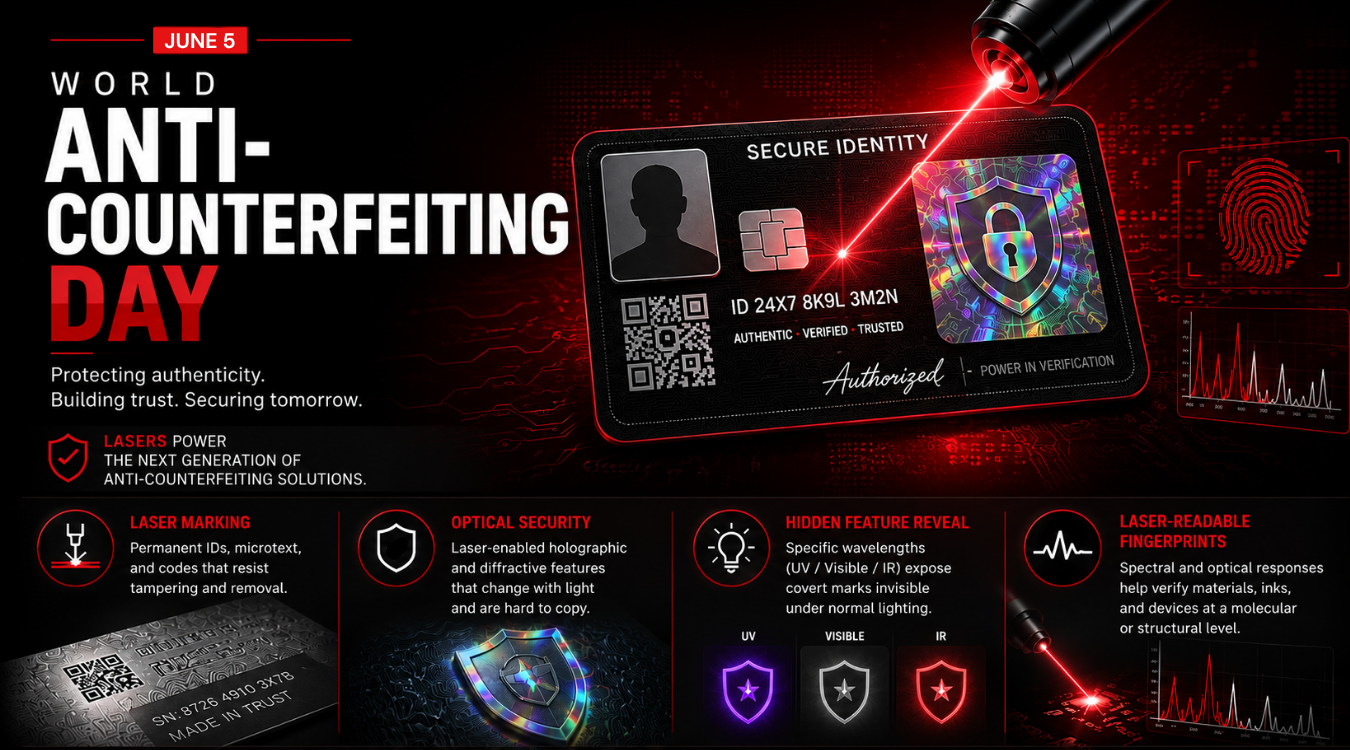
How Lasers Enable Modern Anti-Counterfeiting
From permanent marks and diffractive security features to Raman signatures, fluorescence, speckle, and optical fingerprints, lasers help turn authenticity into something that can be measured.
Core idea: lasers are not a standalone anti-counterfeiting solution. They are enabling tools used to create durable identifiers, fabricate difficult-to-copy optical features, and interrogate hidden spectral or structural signatures.
Counterfeiting is no longer just a packaging problem. For high-value components, electronics, medical devices, pharmaceuticals, luxury goods, identity documents, and industrial parts, the outside of a product can often be copied well enough to pass a casual inspection.
The harder question is this: can the physical object prove that it is the right object?
That is where lasers matter. They create permanent identifiers, write optical security structures, activate hidden materials, and interrogate chemical or structural signatures that are difficult to judge with the naked eye.
Laser marking creates identity. Optical and spectroscopic features create evidence. Digital verification creates trust.
The OECD and EUIPO estimated that global trade in counterfeit and pirated goods reached about USD 467 billion in 2021, or 2.3% of world trade.
That scale helps explain why authentication has moved beyond stickers and serial numbers into optics, materials science, machine vision, and secure data systems.
The anti-counterfeiting stack is layered
Lasers can support multiple layers of an authentication system. The strongest programs usually combine visible features, hidden features, instrumented readout, and secure data.
-
Good anti-counterfeiting starts with layers Overt, covert, forensic, and digital authentication.
-
Direct laser marking Serialization, microtext, DataMatrix codes, tamper resistance, and substrate-specific laser-material interaction.
-
Diffractive and holographic features Security structures that change with angle, wavelength, and illumination geometry.
-
Covert fluorescence and upconversion Hidden materials that respond to UV, visible, or near-infrared excitation.
-
Laser-written microstructures and optical PUFs Engineered surface structures and random physical fingerprints.
-
Laser readout Raman, SERS, speckle, fluorescence, and spectral fingerprints.
-
Physical marks still need digital trust Serialization, duplicate detection, cryptographic records, and verification workflows.
Good anti-counterfeiting starts with layers
A useful way to think about anti-counterfeiting is in layers:
Overt features
Visible elements the user can inspect directly, such as serial numbers, logos, holograms, color-shifting areas, or printed security graphics.
Covert features
Features that require a tool or special condition, such as UV illumination, NIR excitation, a specific laser wavelength, a polarizer, or a reader.
Forensic features
Signals that require instrumented analysis, including Raman response, fluorescence lifetime, chemical taggants, surface topography, or spectral comparison.
Digital features
Data systems that bind the physical object to a database, certificate, cryptographic signature, or product lifecycle record.
Lasers can participate in all four layers, but they are strongest when the layers work together. A laser-marked QR code is useful for traceability. It becomes a stronger security feature when the code is serialized, enrolled, checked against a trusted record, and protected against replay.
A hologram is useful for visual inspection. It becomes stronger when it includes machine-readable features that respond to a controlled optical challenge.
The goal is not to make counterfeiting impossible. The goal is to make copying expensive, detection practical, and verification repeatable.
Direct laser marking: the practical baseline
The most common laser role in anti-counterfeiting is still direct marking. A focused beam modifies the product, package, or label to create a permanent identifier. That identifier may be human-readable text, microtext, a serial number, a DataMatrix code, a QR code, a logo, or a hidden mark.
The marking mechanism depends on the material and laser parameters. On metals, the process may be annealing, engraving, ablation, oxidation, or surface texturing. On plastics, it may be foaming, carbonization, color change, or additive-dependent contrast. On coated materials, the beam may selectively remove a top layer to reveal the material underneath.
Near-IR / fiber-class systems
Commonly used for metals and selected plastics where absorption and contrast are favorable.
CO₂ laser marking
Often used with organic and non-metallic materials, including paperboard, glass, films, and some packaging substrates.
UV laser marking
Useful when fine features or reduced heat input are needed, especially on heat-sensitive polymers, films, and certain transparent materials.
From an anti-counterfeiting standpoint, the mark itself is only the beginning. A visible serial number can be copied. A QR code can be photographed and reprinted. A high-quality laser mark helps because it is durable and difficult to remove cleanly, but the stronger system is one where the mark is tied to controlled serialization, duplicate-scan detection, chain-of-custody data, or hidden secondary marks.
Diffractive and holographic features: security you can see, and sometimes decode
Holograms became common because they are easy for users to recognize and difficult to reproduce with ordinary printing. Technically, many security holograms belong to a broader class called diffractive optically variable image devices, or DOVIDs. These features use micro- or nano-scale structures to control diffraction, producing visual effects that change with angle, illumination, or viewing geometry.
The photonics behind them is straightforward in principle and complex in execution. A surface relief pattern, grating, or phase structure redirects light in controlled ways. A viewer sees motion, color shift, depth, switching images, or hidden effects because the optical response depends on angle and wavelength.
Lasers may be used to originate holographic masters, expose interference patterns, write computer-generated holograms, or inspect laser-readable features. In more advanced designs, the feature may look like a normal color image under white light but project a hidden holographic image under red, green, or blue laser illumination.
| Feature type | What the user sees | What the system can verify |
|---|---|---|
| Basic holographic label | Color shift, motion, depth, or metallic diffractive effect. | Useful for quick visual inspection, but easier to imitate than high-security machine-readable features. |
| Complex DOVID | Angle-dependent imagery, fine line structures, microtext, or multi-channel effects. | More difficult to replicate because the structure, registration, and optical behavior must all match. |
| Laser-decodable feature | May appear normal or partially hidden under ambient light. | Specific response under controlled wavelength, angle, polarization, or coherent illumination. |
The important caveat: a simple holographic sticker is no longer a high-security solution by itself. The more serious security value comes from combining diffractive features with microtext, demetallization, embedded document layers, machine-readable structures, or wavelength-specific laser reconstruction.
A good diffractive feature does not merely “look shiny.” It behaves predictably under a controlled optical challenge.
Covert fluorescence and upconversion: hidden marks that respond to the right light
Another major laser-enabled anti-counterfeiting tactic is the use of materials that are invisible, muted, or ordinary-looking under ambient light but respond under specific illumination.
The simplest version is UV fluorescence. A hidden ink, coating, varnish, fiber, or particle emits visible light when excited with ultraviolet radiation. That can be useful, but it is also relatively easy to understand and sometimes easy to imitate.
More advanced systems use engineered luminescent materials with specific excitation and emission behavior. These can include phosphors, lanthanide-doped particles, quantum dots, fluorescent polymers, photochromic materials, or upconversion nanoparticles. Some materials respond only to particular wavelengths. Others encode information in emission color, intensity ratio, decay lifetime, polarization, or time-gated response.
Stokes-shifted fluorescence
The material absorbs higher-energy light and emits lower-energy light. A common example is UV excitation producing visible emission.
Upconversion response
The material absorbs lower-energy photons, often in the near-infrared, and emits higher-energy visible photons. This can support covert NIR-activated security features.
For a photonics audience, the useful design questions are more specific than “UV or IR.” They include excitation wavelength, required optical power density, substrate background fluorescence, emission filtering, reader geometry, environmental durability, and whether the signal is based on color, intensity, spectral ratio, lifetime, or a coded response.
Laser-written microstructures and optical PUFs
Some of the most technically interesting anti-counterfeiting work is happening at the surface-structure level.
Instead of printing a visible label or depositing an ink, lasers can write micro- and nano-scale patterns directly into a material. Depending on pulse width, fluence, wavelength, polarization, scan strategy, and substrate, laser processing can create gratings, oxide layers, craters, ripples, roughness, color centers, plasmonic structures, or controlled damage zones.
Deterministic structures
The laser writes a designed feature such as a grating, structural color region, direct laser interference pattern, or controlled diffractive surface.
Stochastic structures
The process creates a random but measurable physical fingerprint. This is the basis of a physical unclonable function, or PUF.
A PUF is not secure because nobody can see it. It is secure because even the original manufacturer cannot perfectly reproduce the same microscopic randomness on a second part. The authentic item is enrolled at manufacturing, then later challenged by a reader. If the measured response matches the enrolled template within tolerance, the item passes.
This is powerful, but it is not magic. PUF systems live or die by enrollment quality, reader repeatability, environmental durability, tolerance windows, and attack model. If the reader is unstable, the PUF fails good parts. If the matching threshold is too loose, it accepts bad ones.
The engineering challenge is to design a feature that is random enough to resist cloning, stable enough to survive real use, and measurable enough to verify quickly.
Laser readout: Raman, SERS, speckle, and spectral fingerprints
Not every anti-counterfeiting laser marks the product. Some interrogate it.
Laser-based readout is useful when the authenticating feature is chemical, spectral, structural, or hidden below normal visual inspection. Raman spectroscopy is a common example. A laser excites the sample, and the resulting inelastic scattering provides a molecular fingerprint. That fingerprint can help distinguish genuine materials, coatings, inks, polymers, pharmaceuticals, or security taggants from substitutes.
Surface-enhanced Raman scattering, or SERS, takes the concept further by using plasmonic structures to amplify Raman signals from reporter molecules. This can support high-density labels with narrow spectral features rather than broad, easily confused fluorescence bands.
Laser speckle can also be useful. When coherent light reflects from or transmits through a rough or complex surface, it generates a speckle pattern that depends on microscopic structure. That pattern can act like an optical fingerprint if the geometry, illumination, and detection conditions are controlled.
| Readout method | What it measures | Best-fit use case |
|---|---|---|
| Fluorescence | Emission wavelength, intensity, ratios, or lifetime after optical excitation. | Covert inks, fibers, coatings, particles, and machine-readable packaging marks. |
| Raman | Molecular vibrational fingerprint from inelastic scattering. | Material verification, security taggants, pharmaceuticals, coatings, and forensic inspection. |
| SERS | Enhanced Raman signal from plasmonic structures and reporter molecules. | Compact spectral tags, high-specificity labels, and advanced authentication schemes. |
| Speckle / surface fingerprint | Coherent scattering pattern tied to microscopic surface structure. | Optical PUFs, direct part authentication, and surface-unique security features. |
For laser readout, the source matters. Wavelength, linewidth, beam shape, pointing stability, optical noise, output power, thermal management, modulation, and package integration can all affect signal-to-noise ratio and reader repeatability. In a lab, those details are manageable. In a field-deployed reader, they become the product.
The physical mark still needs digital trust
A physical feature can prove that something is hard to copy. It does not automatically prove that the product is legitimate.
That distinction matters. A valid QR code can be copied. A real hologram can be diverted. A genuine package can be refilled. A serialized code can be reused. Anti-counterfeiting systems need to consider not just fabrication, but also enrollment, verification, revocation, duplication detection, and data governance.
Create the physical feature
A laser or optical process creates a durable mark, structure, hidden response, or spectral tag.
Enroll the item
The identity or optical fingerprint is captured and associated with a trusted production record.
Interrogate the feature
A reader extracts identity, spectral response, optical behavior, image data, or surface signature.
Verify the state
The system checks whether the feature matches an enrolled record and flags duplicates, invalid states, suspicious locations, or unexpected scan patterns.
That is the difference between a mark and an authentication system.
What photonics teams should pay attention to
For teams building anti-counterfeiting systems, the laser is not just a commodity light source. The optical architecture affects the entire security model.
The strongest systems usually do not rely on one clever trick. They create asymmetry. The legitimate manufacturer can produce, enroll, and verify a feature repeatably. The counterfeiter has to copy the material, the optical response, the data record, the reader behavior, and the process history.
That is where lasers earn their place in anti-counterfeiting: not because they make an object impossible to copy, but because they make authenticity measurable.
Building the next generation of anti-counterfeiting technology?
Power Technology, Inc. has been a USA-based laser manufacturer since 1969, designing and manufacturing laser products for scientific, biomedical, industrial, semiconductor inspection, machine vision, defense, and security applications.
If your team is developing an authentication reader, covert illumination source, spectral inspection platform, laser marking architecture, or another laser-enabled security technology, reach out to Power Technology to discuss wavelength selection, beam quality, packaging, lifecycle support, and custom laser capabilities.
Contact Power Technology Explore Laser CapabilitiesSources and further reading
- OECD / EUIPO, Mapping Global Trade in Fakes 2025: https://www.euipo.europa.eu/en/publications/mapping-global-trade-in-fakes-2025
- ISO 22383, Security and resilience — Authenticity, integrity and trust for products and documents: https://www.iso.org/standard/50285.html
- KEYENCE, laser marker selection and direct part marking resources: https://www.keyence.com/products/marker/laser-marker/
- Kinegram, secure hologram technology overview: https://www.kinegram.com/events-insights/details/what-is-secure-hologram-technology
- Nature Communications, holographic color printing and laser-revealed security imagery: https://www.nature.com/articles/s41467-018-07808-4
- Nature, lanthanide-doped luminescent nanocomposites for multimode anti-counterfeiting: https://www.nature.com/articles/s41377-022-00813-9
- Nature Communications, high-speed laser writing of structural color: https://www.nature.com/articles/s41467-023-36275-9
- Nature Communications, laser-generated random anticounterfeiting tags: https://www.nature.com/articles/s41467-024-51756-1
- Nature Communications, SERS physically unclonable anticounterfeiting labels: https://www.nature.com/articles/s41467-019-14070-9
- ISO/IEC 20248, automatic identification and data capture techniques: https://www.iso.org/standard/81314.html
- GS1 Digital Link standard: https://www.gs1.org/standards/gs1-digital-link