Beyond Wavelength + Power: How to Specify an OEM Laser
Power Technology, Inc.2026-09-29T19:51:34-05:00Beyond Wavelength + Power
Wavelength and optical power are usually the first two laser specifications engineers discuss. They are important—but they rarely define whether a laser will actually work inside an OEM system.
A laser is more than a wavelength-power pair
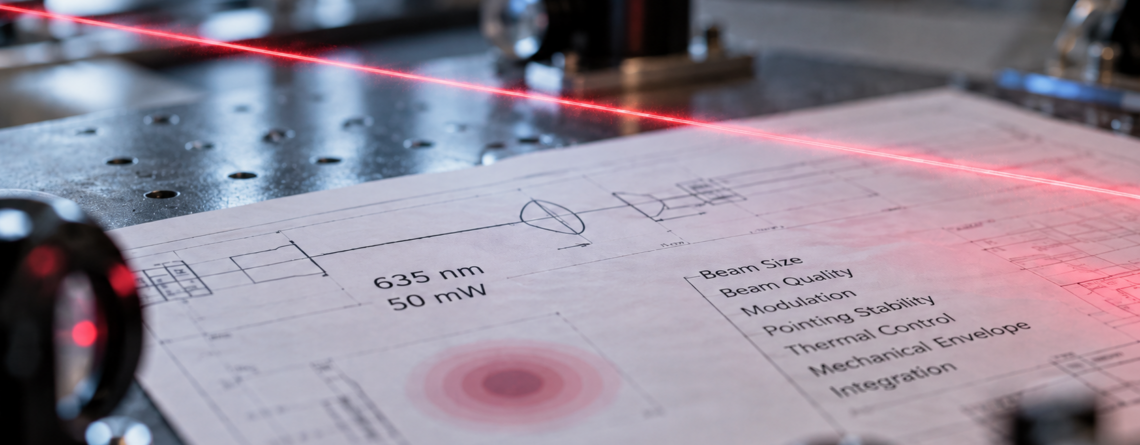
A request for a 635 nm, 50 mW laser sounds specific. From an engineering perspective, however, most of the system requirement is still open.
Does the beam need to be 1 mm or 10 mm wide at the target? Is that target 50 mm away or 50 meters away? Does the laser operate continuously, switch from a digital signal, follow an analog waveform, or produce defined pulses? Does it have to fit inside a narrow bore? Maintain wavelength stability as temperature changes? Survive vibration? Couple into a fiber? Run as one prototype—or as a controlled component in a multi-year production program?
Two lasers can have the same nominal wavelength and optical power while being fundamentally different systems. The better starting question is therefore not simply “What laser do you need?” but “What does the light need to do inside the instrument?”
Optical behavior
Wavelength, spectrum, beam size, divergence, focus, polarization, pointing, and spatial quality.
Control behavior
CW operation, analog modulation, digital switching, pulse timing, interfaces, and synchronization.
Physical reality
Diameter, length, mounting, connectors, cable exits, fiber routing, heat sinking, and available volume.
Operating context
Temperature, vibration, contamination, supply power, qualification, quantity, and product lifecycle.
Even “wavelength” can mean more than one number
A nominal wavelength identifies the approximate spectral region, but some applications also depend on how tightly that wavelength is controlled.
Depending on the application, engineers may need to consider nominal center wavelength, allowable tolerance, spectral width, longitudinal-mode behavior, wavelength drift, and stability over operating conditions.
Semiconductor-laser emission is temperature dependent. Junction temperature affects semiconductor and cavity properties, while drive conditions can also influence the operating temperature of the device. The resulting wavelength shift is device- and architecture-dependent; it should be taken from data for the actual diode or laser system rather than assumed from a generic coefficient.
Alignment
A nominal visible wavelength may be sufficient when visibility and detector response dominate the requirement.
Analytical instrument
Wavelength tolerance and drift may matter because filters, samples, or detector response are spectrally selective.
Coherent / spectral system
Linewidth, longitudinal mode behavior, coherence, and wavelength stability may become primary specifications.
OEM production
The specification may also need limits that remain repeatable from unit to unit and across expected operating conditions.
Optical power is not the same thing as irradiance
Total optical power tells you how much optical energy is delivered per unit time. It does not tell you how concentrated that power is at the plane where the application uses it.
For an ideal circular Gaussian beam, the transverse irradiance distribution at a given plane can be written as:
Example assumes ideal circular Gaussian profiles at the same plane. Real beams can be elliptical, multimode, astigmatic, clipped, or otherwise non-ideal.
Ideal Gaussian irradiance
At the beam center, r = 0, so the peak irradiance becomes:
Because the beam radius w is squared, halving the 1/e² beam diameter increases the ideal Gaussian peak irradiance by a factor of four at that plane.
The beam has to work where the application happens
A beam diameter at the laser aperture describes one plane. Most OEM applications care about another.
Laser output
Beam size, X/Y geometry, wavelength, polarization, and initial propagation conditions.
Propagation & optics
Distance, divergence, lenses, scanners, apertures, windows, fibers, or other system optics.
Application plane
Required spot size, beam diameter, irradiance, uniformity, focus, alignment, or coupling condition.
Laser beams cannot remain perfectly parallel indefinitely. Diffraction connects beam size and divergence, and real systems add beam quality, astigmatism, asymmetric X/Y behavior, lens aberrations, clipping, and alignment tolerances.
A requirement such as “2 mm beam” is therefore incomplete if the location is unknown. A more useful statement is “≤2 mm beam diameter at 500 mm from the output aperture.”
That one addition—the plane where the requirement applies—can materially change the optical design.
Which beam parameters actually matter?
Not every application requires every parameter below. The goal is to identify which ones control system performance.
Possible optical requirements
- Beam diameter
- Working distance
- X/Y divergence
- Required spot size
- Beam shape
- Focus location
- Polarization
- Pointing stability
- Spatial mode
- M²
- Astigmatism
- Free-space vs. fiber
What the terms tell you
- Beam diameter
- Transverse beam size at a defined plane and according to a stated measurement convention.
- Divergence
- How rapidly the beam expands with propagation. Diode-laser X and Y values can differ.
- Working distance
- The distance from the output reference plane to the target or plane where beam performance matters.
- M²
- A beam-quality factor describing propagation and focusability relative to an ideal diffraction-limited Gaussian beam.
- Pointing stability
- How the optical axis changes as time, temperature, drive conditions, or environment change.
- Polarization
- The polarization state and orientation, plus an extinction or polarization-ratio requirement when the application depends on it.
Beam-quality topics such as M², waist location, Rayleigh range, and beam-parameter product deserve their own treatment; they are intentionally not reduced to one number here.
“Modulated” is not a complete specification
Once the optical geometry is defined, the next question is what the laser needs to do over time and how the host system will command it.
Continuous Wave
Continuous optical emission during the required operating interval. Stability and startup behavior may still matter.
Digital / TTL
Digital switching requires a defined interface, logic behavior, frequency, rise/fall time, duty cycle, and timing expectations.
Analog
Optical output follows an analog command. Bandwidth, input range, bias, modulation depth, and linearity may become important.
Pulsed
Pulse width, repetition rate, pulse energy, peak power, timing jitter, and duty cycle can all matter. Average and peak power are not interchangeable.
What has to fit where?
A laser can meet every optical requirement and still fail the system requirement because it physically does not fit.
Define the physical envelope early
Mechanical information can eliminate impossible architectures before optical or electrical design time is spent on them.
Architecture can move functions
The smallest point-of-emission envelope does not always require the smallest total system. Sometimes the better solution is to put different functions in different places.
Separated geometry redistributes system volume, heat, cabling, and mass; it does not eliminate them.
Temperature control is part of optical performance
Semiconductor-laser behavior changes with device temperature, so the thermal environment can become part of the optical specification.
Depending on diode architecture and operating conditions, temperature can influence center wavelength, threshold current, optical efficiency, output behavior, spectral behavior, and lifetime. The magnitude of these effects is device-dependent.
Precision laser systems may therefore use active thermoelectric control. A thermoelectric cooler, however, does not make heat disappear: it transports heat from one side to the other while consuming electrical power, so the host system still needs a suitable thermal path.
The environment and electrical interface can change the architecture
Environmental requirements
Laboratory assumptions may not apply in a production machine, vehicle, outdoor sensor, or high-temperature instrument.
Electrical / system requirements
An OEM laser is rarely an isolated device. It has to become a controlled subsystem inside another machine.
The specification is coupled
Laser requirements are not a collection of independent numbers. Changing one can affect several others.
P More optical power
S Smaller package
λ Greater wavelength stability
f Faster modulation
The same wavelength and power can lead to very different laser platforms
PTI separates capabilities such as precision temperature control, high-speed modulation, compact geometry, fiber delivery, and extreme-environment operation because those system requirements drive different architectures.
IQ / IQµ
The Instrument Quality platform is designed for high-end OEM applications requiring precision current control and active temperature regulation. IQµ extends the platform with integrated digital control and telemetry.
- Primary design driverOptical / thermal stability
- Temperature controlPID-controlled TEC architecture
- IQµ capabilityIntegrated microprocessor control
- VariantsFree-space, circularized, fiber
SPM / SPMB / SPMC
Separated-geometry modules move driver electronics away from the optical head when the space available at the point of emission is the dominant mechanical constraint.
- ArchitectureSeparated optical head + driver
- Head family12.7 mm / 7.0 mm / 5.8 mm
- Design benefitMechanical placement flexibility
- Important caveatSystem volume is redistributed
PMA / PMT / SPMT
Modulation requirements can determine the electronics architecture. PTI's PMA platform supports analog optical modulation, while PMT/SPMT provide digital modulation for applications that need electronic beam switching.
- PMAAnalog modulation to 20 MHz
- PMT / SPMTDigital modulation to 20 MHz
- SPMT geometrySeparated optical head
- Selection depends onTiming + mechanical constraints
HRM / HRMX
When temperature and environmental exposure dominate the specification, a ruggedized architecture can be more important than selecting from a conventional room-temperature laser family.
- HRMPublished operation up to 85°C
- HRMXPublished operation up to 175°C
- Published enclosureIP67-rated platform
- Design driverEnvironment + thermal durability
IQ4 / IQµ4 & Fiber-Coupled Options
Fiber delivery can separate the laser source from the point of use, change how light is routed through the instrument, and define the output through the selected fiber architecture.
- Integrated IQ pathIQ4 / IQµ4
- System benefitFlexible optical routing
- Selection depends onFiber type + coupling requirements
- Also relevantConnector + bend constraints
Modified & Custom Laser Systems
When no catalog architecture satisfies the optical, mechanical, electrical, thermal, or environmental requirements together, the appropriate path may be a modified-standard or custom design.
- Useful inputsEnvelope + target-plane requirement
- Also defineControl + environment
- Program contextPrototype + annual quantity
- GoalDesign around the application
The first laser and the thousandth laser may have different priorities
A laboratory prototype often prioritizes immediate availability and adjustability. An OEM production program may also care about repeatability, configuration control, supply continuity, assembly time, documentation, qualification, serviceability, and system-level cost.
That means quantity and lifecycle are not merely purchasing details. They can influence whether the best path is a standard catalog laser, a modified-standard configuration, or an application-specific design optimized around the production system.
Prototype quantity
How many units are needed to prove the optical and system architecture?
Annual volume
Will the design be repeated tens, hundreds, or thousands of times?
Program life
How long must the design, documentation, and supply strategy remain controlled?
Qualification
What testing, records, configuration control, or validation must accompany production?
What should you define before selecting an OEM laser?
You do not necessarily need every parameter below. You need the parameters that determine whether the laser succeeds in your system.
Beyond wavelength + power
| Category | Define When Relevant | Why It Can Matter |
|---|---|---|
| Wavelength | Nominal wavelength, tolerance, allowable drift | Source compatibility with samples, filters, detectors, coatings, and system optics |
| Spectrum | Spectral width, longitudinal-mode requirements, coherence | Relevant in spectral, interferometric, sensing, and coherence-sensitive systems |
| Power | Minimum / typical output, stability, noise, peak vs. average | Defines optical-energy availability but not concentration at the target |
| Beam | Diameter, X/Y divergence, shape, M², astigmatism, polarization | Controls propagation, focusing, alignment, coupling, and interaction with downstream optics |
| Application plane | Working distance, required spot or beam size, target location | Defines what the beam must do where the application actually uses it |
| Operation | CW, analog, digital / TTL, pulsed | Changes driver architecture and host-control requirements |
| Timing | Bandwidth, rise/fall time, pulse width, repetition rate, duty cycle | Determines whether the laser can synchronize with cameras, detectors, scanners, or other electronics |
| Electrical | Supply voltage/current, interface, startup, monitoring | Determines how the laser becomes part of the host system |
| Mechanical | Maximum dimensions, mounting, optical-axis location, connectors, cable route | Can eliminate otherwise acceptable optical architectures |
| Thermal | Ambient range, heat sink, airflow, stabilization, warm-up | Affects achievable stability and whether active temperature control can reject heat |
| Environment | Shock, vibration, contamination, sealing, qualification | Can drive enclosure, mounting, materials, connector, and test requirements |
| Program | Prototype quantity, annual volume, lifecycle, documentation | Can influence the standard-vs.-custom decision and production architecture |
A laser is not a wavelength-power pair
Wavelength and optical power are excellent starting points. They tell us a great deal about the light that must be generated.
But beam geometry, spectrum, working distance, polarization, modulation, temperature, packaging, electronics, environment, and production requirements determine whether that light will actually work inside the instrument.
A useful first conversation does not require a hundred-line specification. Start with the application: What should the beam do? Where does it need to do it? How does it need to be controlled? What space is available? What environment will it operate in? And how many systems will ultimately be built?
Those answers often reveal the appropriate laser architecture much faster than another decimal place in wavelength or optical power.
Bring us the application—not just the nanometers and milliwatts
Tell Power Technology the wavelength, power, target-plane beam requirement, control method, mechanical envelope, electrical interface, thermal environment, and program needs. Our team can help determine whether the appropriate solution is a standard laser module, a modified configuration, or a custom OEM laser system.
Published product and technical resources used for this article
- Power Technology Laser Diode Modules
- Instrument Quality (IQ Series)
- IQµ / IQu Microprocessor-Controlled Laser Modules
- SPM / SPMB / SPMC Separated-Geometry Lasers
- PMA Analog Modulation Lasers
- PMT / SPMT Digital Modulation Lasers
- Fiber-Coupled Laser Modules
- HRM / HRMX Extreme-Environment Laser Platform
- Power Technology Laser Calculators
- Newport Application Note: Controlling Temperatures of Laser Diodes Thermoelectrically